New this week
Browse tools recently added to the directory by publication date, then check features, pricing, and limits on their detail pages.
Added in the last 7 days
Start here if you want the shortest answer to “what is actually new on the site this week?”

Pixform offers image-to-image style transformation and a separate two-photo still-image face-swap workflow. Public terms describe limited free use without signup; GIF, selectable multi-face and video swaps are not available in this release.

MossImage is an independent browser-based image studio with MOSS-Image generation, JSON layout controls and other image models. Its published plans use credits; exact account access and current availability were not tested.
Hailuo AI is a video and image creation workspace for turning images or text into short videos. Plans, credits, watermark-free downloads and output rights depend on the current plan and applicable terms; this listing does not claim product-image fidelity or account-tested entitlements.
Kling AI is a consumer creative studio for generating and editing video and images from text and visual references. Free availability, credits, model access, watermark removal and commercial-use terms depend on account, region, offer and applicable plan terms.

OmniRoute provides a self-hosted gateway for routing AI requests across configured providers. The MIT software is free to use; upstream credentials, quotas and model charges remain separate.

MOSS-Image is a 5B open-weight image model with text and layout controls. Local inference requires compatible compute; no unified hosted API or price has been verified.
Browse this week by category
If you only care about certain use cases, this section groups the newest additions by category so you can jump in faster.
Category
Design & Art
5 newly added tools in the last 7 days.
Category
Other
1 newly added tools in the last 7 days.
Earlier additions
These tools joined the directory before this week. Compare their capabilities, pricing, and usage limits.
CADCraft is a free open-source CAD editor with MCP, JSON control and CLI surfaces for external agents. It does not bundle a generative AI model; compare file fidelity and setup before use.
Anthropic OSS Scanner offers no-cost model-driven security scans to eligible critical open-source projects. Core maintainers apply by PR, and fast-track reports are not human-reviewed.
Grok Voice API is xAI's real-time voice-agent platform for speech-to-speech, text-to-speech and speech-to-text workflows. Grok Voice 3.0 is the current speech-to-speech model reviewed here; compare integration, interruption handling and measured task cost with ElevenLabs and Murf before deployment.

Lindy is an AI teammate for delegated work across connected tools, shared context and scheduled routines. Compare approvals, credit use and per-seat cost with n8n and Make before choosing it.

WellSaid Studio turns scripts into editable AI voiceovers with voice selection and pronunciation controls. Compare paid download rights, team workflow and revision costs before choosing it.
Cloudflare Clef groups Clef, Clef-flash and Clef-omni for probability-based typed decisions. Their input modalities, hosted context windows and rates differ; verify the route before use.

Melty is a Windows game-mashup and mod platform with a coding-agent creation route. Publishing grants Melty an exclusive marketplace licence that persists 12 months after removal.

ArtCraft combines scene composition, layers and AI image/video models in an open-source creative studio. Check plan credits, model access and output rights for your account.
Muse Wonder is Meta's coding and agent model family. Wonder and Wonder Full have different access paths; this is a model layer, not a ready-made app builder.

Everygen combines AI short-video creation, ad templates, scripts, voiceover and exports. Check source-media rights, the selected model and credit costs before publishing.
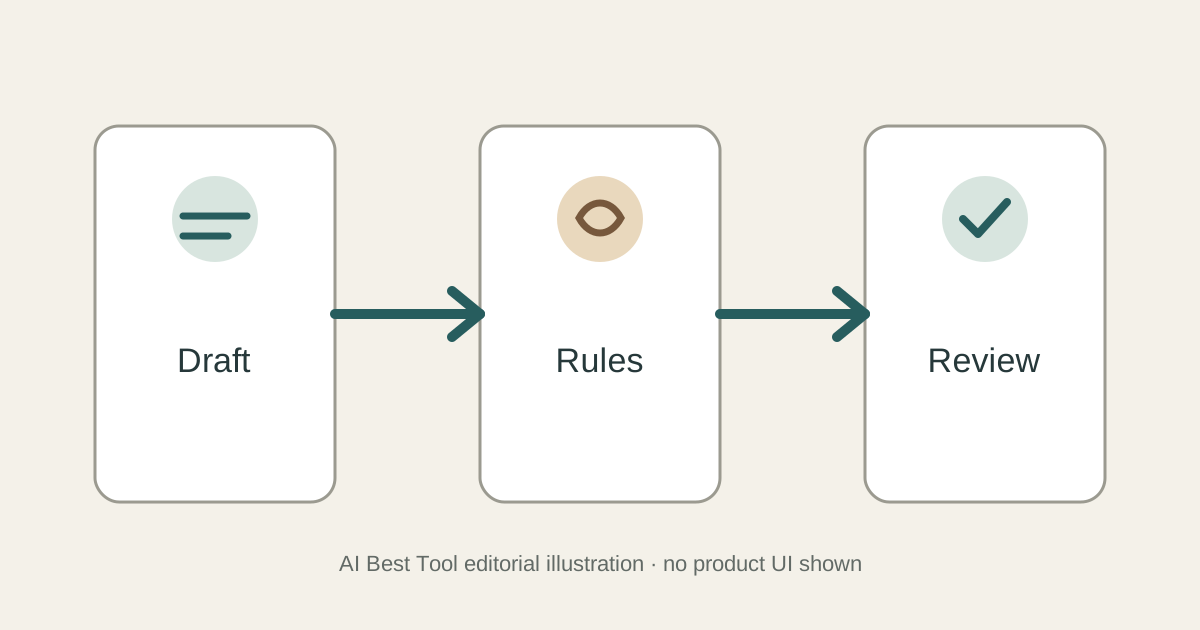
WRITER is an enterprise AI agent platform with brand voice, terminology, and style settings for marketing content workflows. This listing covers the product and configuration path, not a measured output-quality guarantee.

ProHoster offers NVMe VPS, shared hosting, dedicated servers, and VPN for a range of business and development needs. Hosting plans include free SSL, a domain, AI website builder, and DDoS protection. VPS solutions feature KVM and OVZ virtualization, unlimited traffic, and a free control panel. Dedicated servers come with full root access, up to 1Gb/s channels, and DDoS protection. The VPN service supports unlimited devices and over 75 locations. 24/7 support and instant deployment are included.